
About this fungus
Golden Chanterelle is a fungus in the Cantharellaceae family. Its habitat and field characteristics are summarised below.
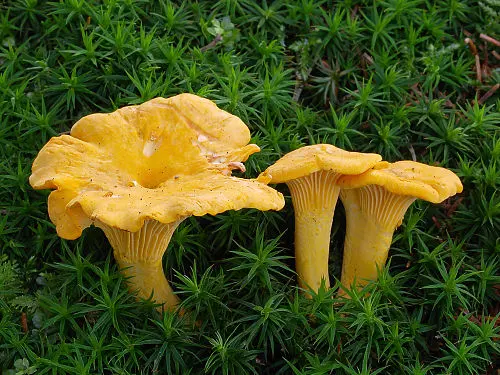
A firm yellow woodland mushroom with an irregular funnel-shaped cap and a solid stem that merges smoothly into the cap. Beneath it are blunt branching folds, not separate blade-like gills.
What to check
Follow the underside down the stem. The fertile surface forms shallow, blunt, forked and cross-connected ridges that are part of the flesh and cannot be separated as individual gill blades. The interior is solid and pale, without a ring or volva, and the spore print is cream to pale yellow. A fruity smell can support an identification but is variable and not decisive.
Variation
Colour ranges from pale lemon-yellow to deep egg-yellow or yellow-orange. Caps begin rounded and become wavy, lobed and depressed, while damage can produce faint reddish marks. Golden chanterelles form a worldwide species complex, and the strict European C. cibarius name should not be applied automatically in North America or other regions.
Lookalikes
False Chanterelle has thin, crowded, repeatedly forked true gills that can be separated from the cap flesh and often grows with woody debris. Jack-o'-lantern species are poisonous, grow in clusters from wood or buried roots and have sharp true gills. Regional chanterelle species can look almost identical to C. cibarius, so the app description identifies the golden-chanterelle form while acknowledging that the exact name depends on region.
Habitat and range
Ectomycorrhizal on woodland soil. European C. cibarius occurs with broadleaved trees and conifers, including oak, beech, birch, pine and spruce, with soil preferences varying locally. Similar golden chanterelles elsewhere have their own regional tree partners.
Food safety
Choice edible.
Use this profile to learn what to examine and compare, not as proof that a mushroom is safe to eat. Check the whole specimen and every important lookalike before reaching an identification.
Photographs
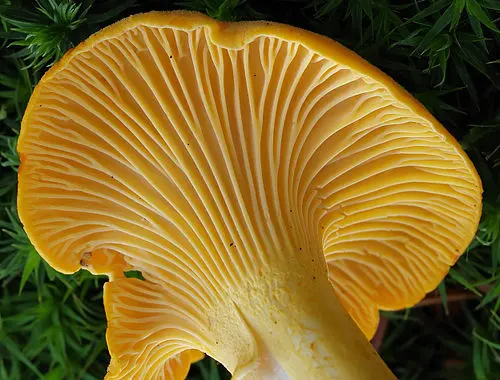 Andreas Kunze / CC BY-SA 3.0
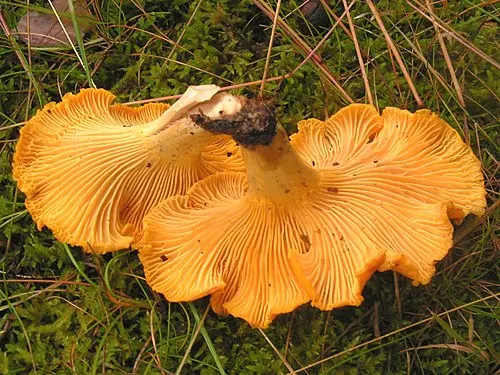 Teun Spaans / CC BY 2.5
Species to compare
Similar mushrooms to compare against: