

About this fungus
Grey-veiled Amanita is a fungus in the Amanitaceae family. Its habitat and field characteristics are summarised below.
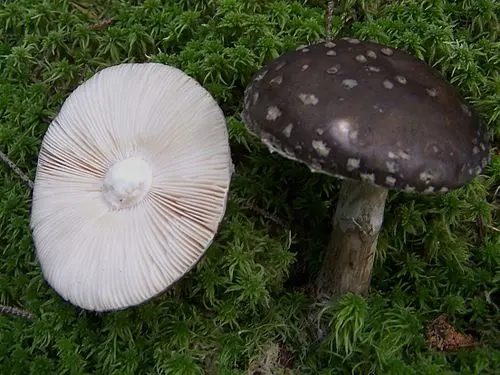
A slender woodland Amanita with a smooth grey-brown to purplish-brown cap, usually carrying a few grey veil patches. It has free white gills, a thin upper ring and a broad basal bulb edged by a close-fitting rim.
What to check
Expose and inspect the entire stem base. The bulb is broad and normally has a distinct rim or margin rather than a loose sack. Check the free white gills, white spore print, thin greyish ring and grey veil patches together. The ring may collapse and cap patches can wash away, so neither is reliable alone.
Variation
The cap ranges from pale grey-brown to dark purplish-brown and can look shinier when moist. Veil remnants vary from several grey patches to almost none after rain. The ring is often fragile, while the bulb may remain hidden in soil unless the whole base is examined.
Lookalikes
False Death-cap, Amanita citrina, is usually paler and often has a raw-potato smell, but it shares a margined bulb. Panthercap, Amanita pantherina, often has whiter cap patches and a differently ridged bulb, yet weathered specimens can overlap. Other grey-brown Amanita species may require microscopy or specialist regional knowledge.
Habitat and range
Ectomycorrhizal on acidic woodland soil with conifers and broad-leaved trees, including spruce, pine, birch and beech. It is best documented across Europe and northern temperate regions and fruits mainly from summer into autumn.
Food safety
Inedible.
Photographs
 Jerzy Opioła / CC BY-SA 3.0
Species to compare
Similar mushrooms to compare against: