
About this fungus
Hairy Curtain Crust is a fungus in the Stereaceae family. Its habitat and field characteristics are summarised below.
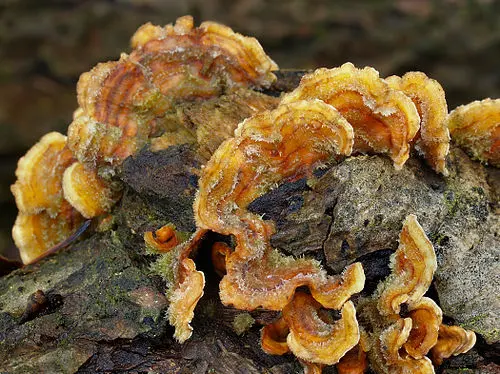
Thin, tough crusts and small overlapping brackets on dead wood, warmly zoned in yellow, orange and brown. Fresh upper surfaces and margins are conspicuously hairy, while the fertile underside is smooth.
What to check
Turn a bracket over. The lower fertile surface is smooth, without gills or visible pores, and is usually paler and less strongly zoned than the upper face. Individual wavy brackets are commonly 2 to 8 cm across but frequently fuse into long tiers. The upper face is coarsely hairy when fresh, and torn tissue does not normally release the red fluid seen in some related Stereum.
Variation
Yellow, orange and brown zones darken and lose contrast with age. Hairs wear away on old brackets, and algae can give weathered surfaces a green cast. Flat crust-like growth and projecting shelves may occur together.
Lookalikes
Trametes versicolor has a surface of minute pores underneath rather than a smooth fertile face. Stereum subtomentosum is usually more narrowly attached and often greyer-orange. Stereum gausapatum and related bleeding crusts exude red fluid when freshly damaged, although old or dry material may respond weakly.
Habitat and range
Saprobic on dead hardwood stumps, logs and fallen branches, especially oak and beech, with occasional records on conifer timber. Persistent brackets can be seen year-round, with spore release often strongest in autumn.
Food safety
Inedible.
Photographs
 Norbert Nagel / CC BY-SA 3.0
Species to compare
Similar mushrooms to compare against: