

About this fungus
Horse Mushroom is a fungus in the Agaricaceae family. Its habitat and field characteristics are summarised below.
A large, sturdy mushroom of fields, lawns and grassy verges. The smooth cap is white to cream when young and often becomes yellowish or buff with age. A sweet smell of aniseed, almond or marzipan is common, while the gills change strikingly from pale pink to chocolate brown as the mushroom matures.
What to check
Check several features together. The gills are crowded and free from the stem, beginning pale pink and maturing to dark brown. The stem carries a large double ring whose underside often breaks into a cogwheel pattern, and there is no cup or volva at the base. The cap and stem may yellow slowly, especially with age or handling, and the flesh often smells sweetly of aniseed or almond. A chocolate-brown spore print confirms Agaricus rather than a white-spored Amanita, although exact Agaricus identification can still be difficult.
Variation
Young caps can be almost pure white and rounded, while older caps expand broadly and may become cream, pale yellow or buff. The sweet smell can be strong, faint or difficult for some people to detect. Yellowing is usually gradual rather than the rapid vivid yellow reaction associated with the Yellow Stainer group. Size varies greatly, with exceptionally large specimens well beyond the usual range.
Lookalikes
Yellow Stainer, Agaricus xanthodermus, can share the same grassland habitat but usually turns bright yellow rapidly at the stem base and often has an inky, phenolic or chemical smell. Horse Mushroom itself can yellow, so staining speed, location, ring structure and smell must be considered together. Field Mushroom has a simpler ring and lacks the typical aniseed smell. Very young white Amanita species can resemble closed Agaricus buttons; a volva at the stem base, persistently white gills and a white spore print point away from Horse Mushroom.
Habitat and range
Saprotrophic on rich soil in pasture, meadows, lawns, parks, roadside verges, gardens and other grassy places. It often fruits in troops, arcs or rings and is not dependent on horses or manure. Records occur across Europe, Asia, North America, Australia and New Zealand, with season varying according to local climate and rainfall.
Food safety
Choice edible.
Use this profile to learn what to examine and compare, not as proof that a mushroom is safe to eat. Check the whole specimen and every important lookalike before reaching an identification.
Photographs
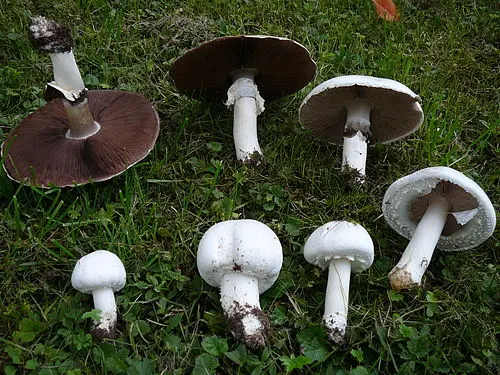 Salix / CC BY-SA 3.0
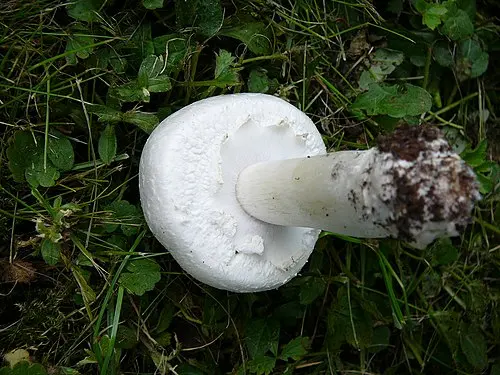 Salix / CC BY-SA 3.0
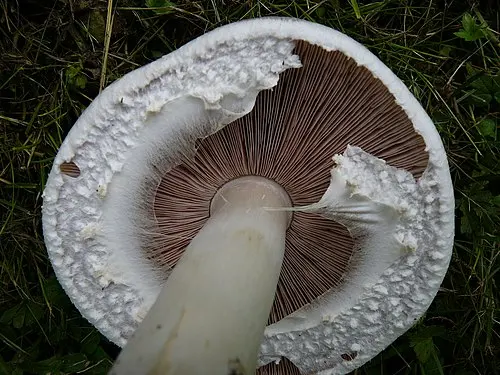 Salix / CC BY-SA 3.0
Species to compare
Similar mushrooms to compare against: