

About this fungus
Late Oyster is a fungus in the Sarcomyxaceae family. Its habitat and field characteristics are summarised below.
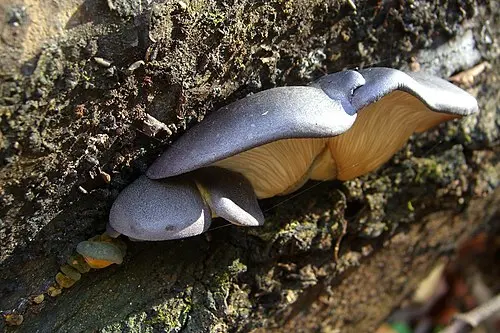
A late-season shelf fungus with an olive, brown or violet-grey tacky cap, warm yellow to ochre gills and a short lateral stem on dead hardwood.
What to check
Check for a smooth tacky cap with at least some olive tone, crowded yellow to orange-ochre gills that run slightly down a short stubby stem, dark scurfy dots on the stem and a cream to pale yellow spore print. The flesh includes a gelatinous layer beneath the cap skin.
Variation
Caps range from olive-green through yellow-brown to violet-grey and may be mottled. Frost and age can darken the surface. The lateral stem may be obvious or reduced to a short attachment point.
Lookalikes
Pleurotus ostreatus usually has white to cream gills and a smoother pale stem without dark scurfy dots. Phyllotopsis nidulans is bright orange throughout with a dry densely hairy cap. Sarcomyxa edulis is an Asian food species formerly confused with S.
Habitat and range
Saprotrophic in overlapping shelves on fallen trunks, logs and large branches, mainly broadleaf wood. It fruits in late autumn and winter across northern temperate forests.
Food safety
Edibility is uncertain or disputed.
Photographs
 Jason Hollinger / CC BY 2.0
Species to compare
Similar mushrooms to compare against: