

About this fungus
Liberty Cap is a fungus in the Hymenogastraceae family. Its habitat and field characteristics are summarised below.
A tiny grassland mushroom with a smooth conical or bell-shaped cap, usually drawn into a clear pointed bump. Damp caps are olive-brown to deep brown and slightly sticky, while drying turns them pale ochre or cream. The long, very slender stem is pale, fibrous and often gently wavy. The whole mushroom may be only a little taller than the surrounding grass.
Identification features to check
Look for a cap about 0. 5 to 2 cm across with a pointed central bump, a translucent lined edge when moist and a strong colour change as it dries. The gills are close and narrowly attached to almost free, changing from grey-olive or pale brown to dark purple-brown as the spores mature. The print is very dark purple-brown. The stem is only around 1 to 3 mm thick, flexible rather than brittle and has no persistent ring. Blue-green colour can sometimes appear near the stem base or after damage, but it is often faint or completely absent and must not be used as a pass-or-fail test.
Variation
Moisture changes the appearance more than any other common factor. A wet cap may be dark olive-brown, glossy and visibly lined at the edge; the same cap can dry through tan to pale straw or cream, often from the centre outwards. The pointed bump ranges from sharp and nipple-like to modest, and an older cap may broaden slightly without becoming flat. Stems vary from almost straight to conspicuously sinuous. Colour photographs can therefore look like several different mushrooms even when they show the same species.
Lookalikes
Many unrelated little brown mushrooms grow in grass, so a pointed cap by itself is not an identification. Brown Mottlegill, Panaeolina foenisecii, is usually broader and lacks the persistent sharp point. Dung Roundhead, Protostropharia semiglobata, grows from dung, has a more rounded sticky cap and can retain a ring. Conocybe and Pholiotina species may also be small and conical, but tend to be more fragile and produce rusty to cinnamon-brown spores rather than a purple-brown print. A forensic review documents mistakes involving Conocybe, and poisonous Galerina have been collected as hallucinogenic Psilocybe. Habitat, cap texture, stem feel, gill attachment and a mature print need to agree; sorting by cap shape alone is unsafe.
Habitat and range
Found among grasses in pasture, meadow, moorland, parkland and similar open turf, often in damp or upland sites. It is associated with nutrient-rich grassland and grazing, but it does not fruit directly from dung. Experimental work found the fungus entering dying outer cells of grassland plant roots, supporting its role in recycling root material. Fruiting is mainly from late summer through autumn in northern Europe, with timing shifting according to local climate in other parts of its broad temperate range.
Food safety
Psychoactive.
Photographs
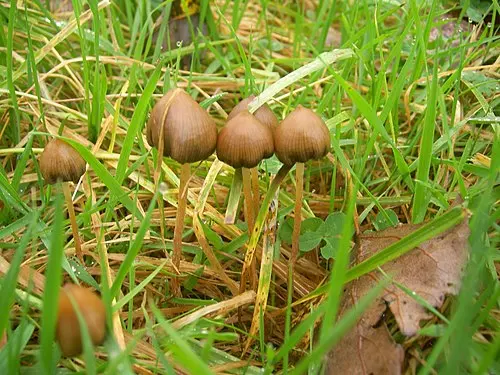 Velghe Dimitri / CC BY-SA 3.0
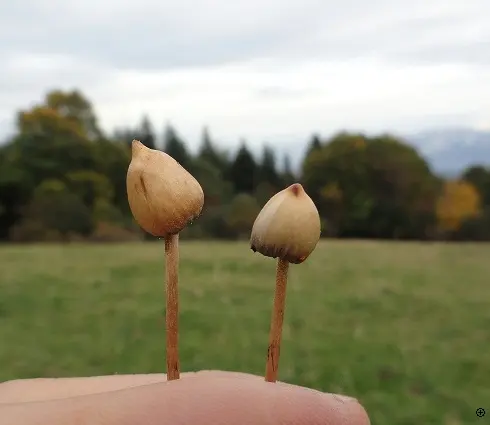 Tageswisdom / CC BY-SA 3.0
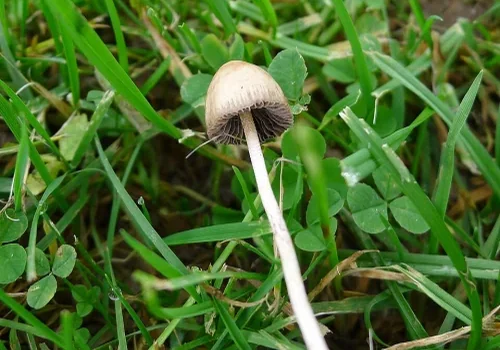 gailhampshire / CC BY 2.0
Species to compare
Similar mushrooms to compare against: