

About this fungus
Mower's Mushroom is a fungus in the Bolbitiaceae family. Its habitat and field characteristics are summarised below.
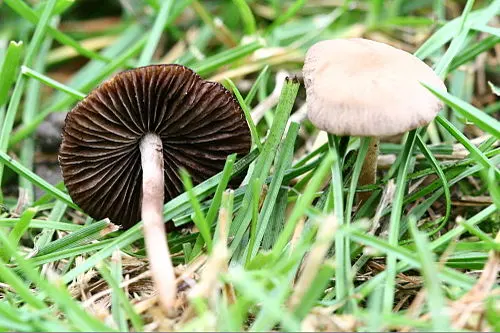
A small, slender brown lawn mushroom whose cap changes markedly as it dries. Damp caps are dark chestnut; drying caps become tan from the centre outward and often retain a darker band near the edge.
What to check
Look for a smooth ringless stem, attached brown gills that become distinctly mottled, and a dark brown to purplish-brown spore print. The print is not jet black. Cap colour alone is unreliable because moisture can transform its appearance within one fruiting body.
Variation
Wet caps may be uniformly dark brown. As they dry they can show several shades at once, from pale buff in the centre to a dark marginal band. Old specimens can become uniformly pale and lose much of this pattern.
Lookalikes
Other small lawn mushrooms include Panaeolus, Psilocybe, Conocybe and Pholiotina species. Panaeolus cinctulus has a jet-black print, while Liberty Cap, Psilocybe semilanceata, usually has a more pointed cap and a different spore-print tone. Some small brown lookalikes are harmful, so a lawn habitat and brown cap do not establish this species.
Habitat and range
Saprotrophic in lawns, mown verges, parks and other grassland, often appearing after rain and recurring after mowing. It is widespread across temperate regions and is not confined to chemically untreated turf.
Food safety
Inedible.
Photographs
 Strobilomyces / CC BY-SA 3.0
Species to compare
Similar mushrooms to compare against: