
About this fungus
Meadow Waxcap is a fungus in the Hygrophoraceae family. Its habitat and field characteristics are summarised below.
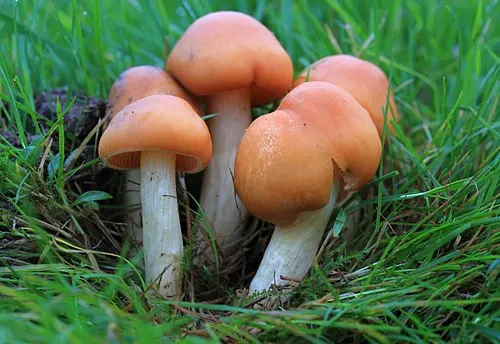
One of the more substantial waxcaps, with a dry rounded cap in muted apricot, tawny or peach tones and thick pale gills running well down the stem. Its sturdy build and widely spaced gills distinguish it from many thin-gilled grassland mushrooms.
What to check
Look for a 3 to 10 cm dry, smooth cap that begins rounded and becomes flatter or shallowly depressed, often with a broad low bump. The thick waxy gills are widely spaced, cross-veined and deeply decurrent. The stout pale buff stem has no ring or volva, and the spore print is white. Use the gill spacing and waxy texture as well as colour because pale forms occur.
Variation
Caps range from apricot and pinkish-orange to ochre-buff, fading as they age or dry. Mature margins may become wavy, split or uplifted. Very pale forms have historically been named separately, and molecular work suggests that some records may belong to a group of related lineages.
Lookalikes
Pale funnels can share the colour and decurrent gills but usually have thinner, more crowded gills. Cuphophyllus virgineus is smaller and much whiter, while the Pink Waxcap has a pointed pink cap that splits as it expands. Regional Cuphophyllus species may require microscopic or DNA evidence when the field characters overlap.
Habitat and range
In Europe it is strongly associated with old, nutrient-poor, unfertilised or lightly managed grassland, including pastures, lawns, parks and churchyards. Woodland records occur in other regions. The nutritional relationship of waxcaps is still under study, so the app does not label this species simply saprobic or mycorrhizal.
Food safety
Edible and good.
Use this profile to learn what to examine and compare, not as proof that a mushroom is safe to eat. Check the whole specimen and every important lookalike before reaching an identification.
Photographs
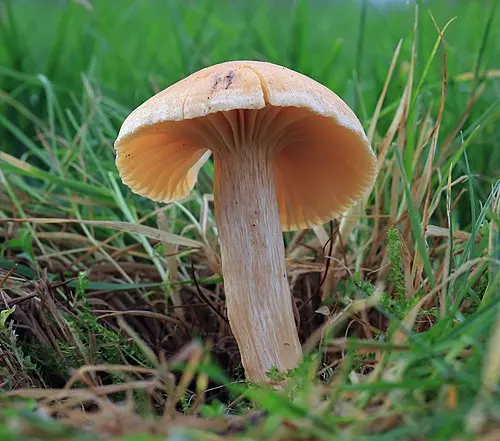 Stu's Images / CC BY-SA 4.0
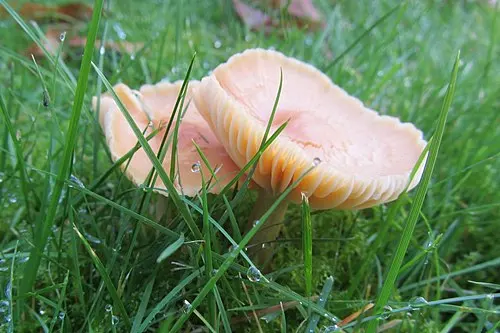 Strobilomyces / CC BY-SA 3.0
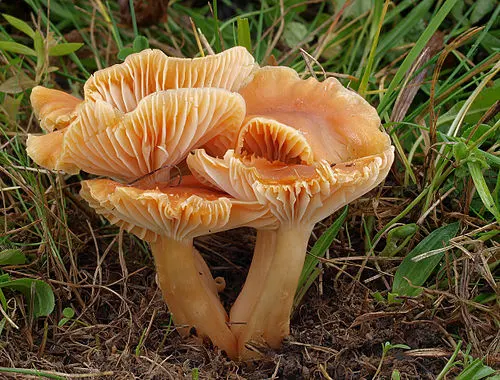 Andreas Kunze / CC BY-SA 3.0
Species to compare
Similar mushrooms to compare against: