

About this fungus
Milking Bonnet is a fungus in the Mycenaceae family. Its habitat and field characteristics are summarised below.
A small, slender bonnet scattered through woodland litter. Its finely striate cap is usually grey-brown with a darker centre and pale edge, and the narrow stem is grey-brown above a tuft of coarse white fibres at the base.
What to check
Break or nick a fresh stem and look for a drop of milk-white fluid. This is the most useful field character, but dry specimens may produce little or none. The gills begin whitish and become pale grey-brown while keeping a paler edge. They meet the stem narrowly and may develop a small downward tooth. There is no ring or volva, and a white spore print supports the identification.
Variation
Typical caps range from grey through grey-brown to dark sepia, usually with a darker centre. Pure white material has been named var. candida. Very dark forms overlap with the Black Milking Bonnet concept, Mycena leucogala, whose separation is not treated consistently by all mycologists. Fluid production also becomes unreliable as the mushroom dries.
Lookalikes
Other grey-brown bonnets can look almost identical when the stem fluid is absent, and microscopy may then be needed. Mycena leucogala is darker and also produces white fluid, but its boundary with M. galopus has long been debated. Bleeding Bonnet and related Mycena release reddish rather than white fluid. Red-edge Bonnet has reddish gill edges and does not produce white fluid.
Habitat and range
Saprotrophic on fallen leaves, twigs and other broadleaf debris, as well as conifer needles, turf and mossy ground including Sphagnum. It occurs in woodland, hedgerows, grassy edges and alpine scrub, usually scattered or in loose groups from summer into early winter in temperate regions.
Food safety
Inedible.
Photographs
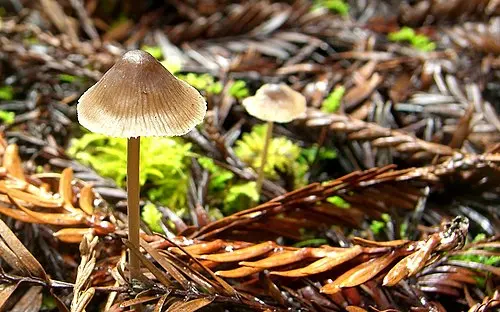 Jason Hollinger / CC BY 2.0
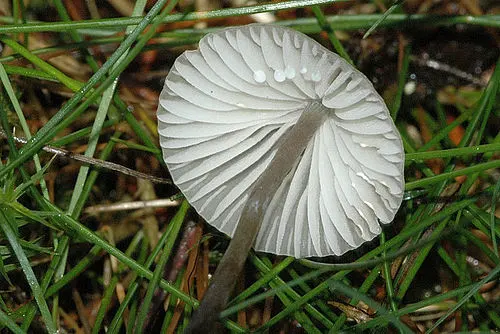 James Lindsey / CC BY-SA 3.0
Species to compare
Similar mushrooms to compare against: