

About this fungus
Pacific Golden Chanterelle is a fungus in the Cantharellaceae family. Its habitat and field characteristics are summarised below.
A firm orange-yellow chanterelle of Pacific Northwest conifer forests. Mature caps become flat or shallowly depressed with a wavy irregular margin, and the solid stem commonly tapers towards the base.
What to check
Confirm blunt, thick, forked and cross-veined false gills running well down the stem, not thin blade-like true gills. The false gills are pale orange-yellow and often show a pinkish cast. Flesh is whitish to very pale yellow, the spore print is whitish to pale yellow, and there is no ring or volva. Typical examples also develop tiny dark scales or a grey-brown surface pigment on the cap.
Variation
Fresh caps range from bright to dull orange-yellow. A greyish to brown pigment layer can appear as tiny scales in dry weather or with age but becomes much less visible in very wet conditions. Pinkish tones on the false gills can also fade in wet specimens, so neither brown scaling nor pink colour is present equally strongly in every collection.
Lookalikes
Hygrophoropsis aurantiaca, the False Chanterelle, has thinner flesh and crowded, thin true gills that fork. Omphalotus olivascens, the poisonous western Jack-o'-lantern, has sharp true gills and usually grows in dense clusters from wood or buried roots. Other Pacific Cantharellus species can be close, and the cap scales and pinkish false gills are variable, so distribution and the full character combination matter.
Habitat and range
Ectomycorrhizal with western hemlock and other conifers in the Pacific Northwest. It fruits on the forest floor alone, in groups or in small clusters in both older and second-growth forest, mainly in autumn and winter. The well-supported range extends from British Columbia through Oregon into northern California; records outside this region require taxonomic checking.
Food safety
Choice edible.
Use this profile to learn what to examine and compare, not as proof that a mushroom is safe to eat. Check the whole specimen and every important lookalike before reaching an identification.
Photographs
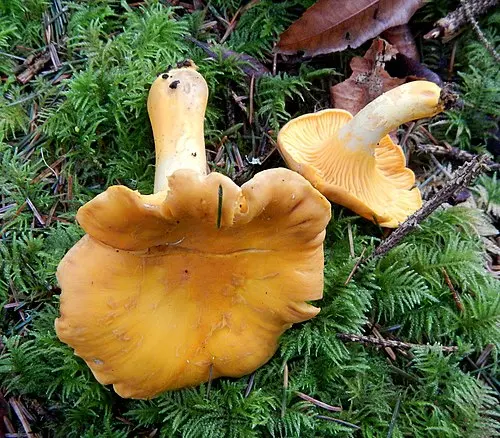 Ron Pastorino (Ronpast) / CC BY-SA 3.0
Species to compare
Similar mushrooms to compare against: