

About this fungus
Pestle Puffball is a fungus in the Agaricaceae family. Its habitat and field characteristics are summarised below.
A tall pestle-shaped puffball with a rounded spore-bearing head above a long tapering sterile base, white when young and brown as it matures.
What to check
Confirm an enclosed puffball with no external gills, pores, cap margin, ring or volva. Section the whole fruit body lengthways: a young true puffball is uniformly solid white inside, without the outline of a cap, gills or stem. Any internal mushroom structure excludes it and may indicate a dangerous Amanita button. A yellow, olive, brown, purple or marbled interior also excludes it from the young white stage.
Variation
Young fruit bodies are white to pale buff with fine warts or soft spines. These wear away as the head becomes ochre-brown and the inside turns olive then dark brown and powdery. The tough sterile base may remain after the upper part disperses its spores.
Lookalikes
Common Puffball is shorter and more pear-shaped. Earthballs have a thick tough rind and soon develop a dark, often purple-black or marbled interior; some are poisonous. Immature Amanita species can look like small puffballs externally but reveal a developing cap, gills and stem when sectioned.
Habitat and range
Saprotrophic on soil in pasture, heath, waste ground, woodland clearings and woodland edges. It occurs across much of Europe and parts of Asia and North America, singly or in groups.
Food safety
Edible.
Use this profile to learn what to examine and compare, not as proof that a mushroom is safe to eat. Check the whole specimen and every important lookalike before reaching an identification.
Photographs
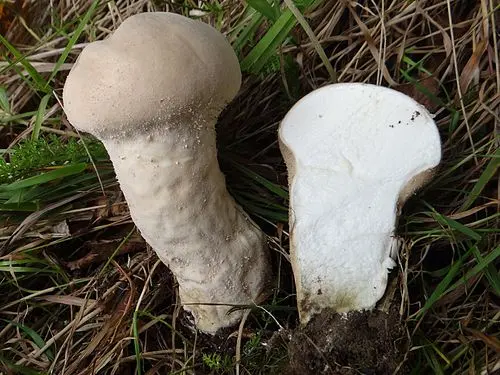 Jerzy Opioła / CC BY-SA 3.0
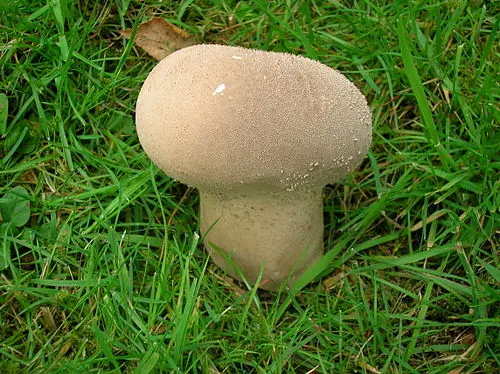 Rosser1954 / CC BY-SA 3.0
Species to compare
Similar mushrooms to compare against: