
About this fungus
Purple-Spored Puffball is a fungus in the Agaricaceae family. Its habitat and field characteristics are summarised below.
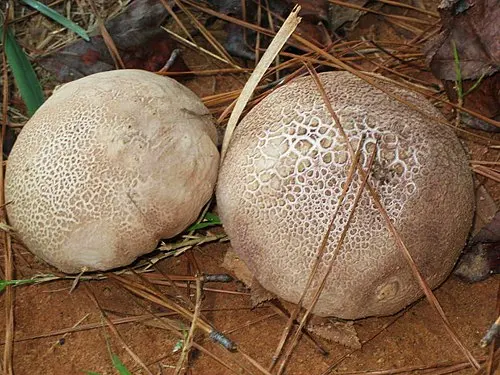
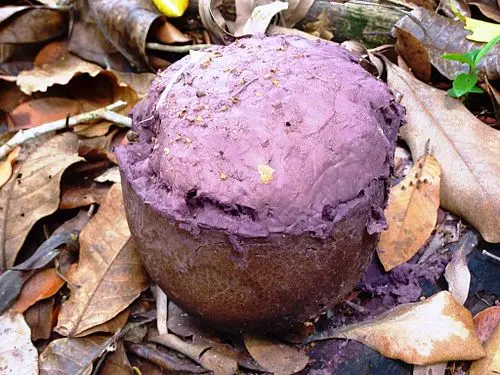
A large grassland puffball that begins rounded and develops a broad upper body above a narrower sterile base. The dry tan surface often breaks into a fine mosaic, while mature specimens reveal the purple-brown spore mass behind the common name.
What to check
Look for a fruit body about 8 to 20 cm across, a dry pale-tan to brown surface with mosaic-like cracking, and a narrower basal portion. A longitudinal section through a young specimen should show an unbroken puffball interior, not the outline of a cap, gills and stem. In this species the upper interior begins white, becomes yellowish and finally turns deep purple-brown and powdery, while the sterile base ages towards olive. The mature spore dust is purple.
Variation
Young fruit bodies can be almost smooth and pale, while older ones become greyer, more strongly cracked and pear-shaped. After the upper wall breaks down and spores disperse, the tough cup-like sterile base may remain on the ground for weeks.
Lookalikes
Calvatia gigantea is usually smoother, whiter and lacks the well-developed sterile base. Calvatia craniiformis has a more sharply narrowed base and a yellow-brown rather than purple mature spore mass. Calvatia fragilis is extremely similar but generally smaller with a less developed base. Immature Amanita buttons show the developing cap, gills or stem when sectioned, while earthballs usually develop a firm dark or marbled interior.
Habitat and range
Saprobic on soil in lawns, meadows, pastures, parks and other grassland. It may grow alone, in groups or in broad rings, mainly in summer and autumn. The species is well documented in North America and Australia, with records elsewhere requiring the usual care over local species limits.
Food safety
Edible.
Use this profile to learn what to examine and compare, not as proof that a mushroom is safe to eat. Check the whole specimen and every important lookalike before reaching an identification.
Photographs
 John Hill / CC BY-SA 3.0
Species to compare
Similar mushrooms to compare against: