

About this fungus
Scurfy Deceiver is a fungus in the Hydnangiaceae family. Its habitat and field characteristics are summarised below.
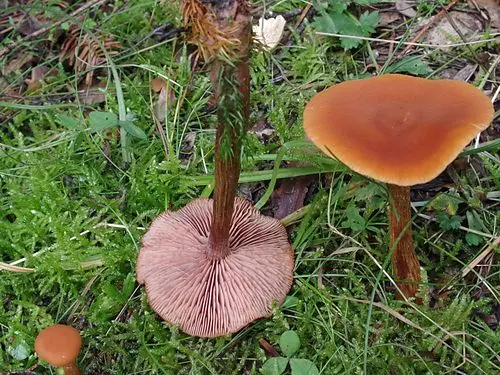
A reddish-brown to orange-brown deceiver with a distinctly roughened or scurfy cap and a tough, fibrous stem.
What to check
Look for a dry cap that becomes more scaly toward the centre, widely spaced pinkish gills and a fibrous stem that is increasingly hairy toward its white-mycelial base. There is no ring or volva, and the spore print is white.
Variation
Moist caps are deeper reddish brown, then fade through buff to almost white as they dry. Size and surface texture overlap with other Laccaria, so faded specimens can be particularly difficult.
Lookalikes
Laccaria laccata can be just as robust and rough-capped. European guides emphasize the scurfy cap, but North American treatments state that confident separation may require the more elliptical, more finely spined spores of L. proxima under a microscope. L. bicolor has lilac mycelium at the stem base when fresh.
Habitat and range
Mycorrhizal on acidic soil in coniferous, mixed or broadleaf woodland and on heath. North American treatments particularly associate it with pines, while European records span a wider range of woodland.
Food safety
Edible.
Use this profile to learn what to examine and compare, not as proof that a mushroom is safe to eat. Check the whole specimen and every important lookalike before reaching an identification.
Photographs
 Jerzy Opioła / CC BY-SA 4.0
Species to compare
Similar mushrooms to compare against: