

About this fungus
The Deceiver is a fungus in the Hydnangiaceae family. Its habitat and field characteristics are summarised below.
A small woodland Laccaria whose orange-pink to reddish-brown cap fades dramatically as it dries. Thick, widely spaced pinkish gills and a tough fibrous stem are more dependable than any single cap colour.
What to check
Compare several fruit bodies and moisture states. Caps begin convex and expand towards flat, often with a slightly lined or wavy margin. The thick, well-spaced gills have shorter gills between them and are attached to the stem, sometimes running down it slightly. The stem is slender, fibrous and increasingly hairy towards the base, with no ring or volva. A white spore print supports Laccaria, but microscopy may still be needed for the exact species.
Variation
Moist caps can be pinkish, orange-brown, reddish-brown or brick-coloured. They fade through pale buff to almost cream in dry weather. Gills are pinkish to flesh-brown when fresh and may look paler as white spores accumulate. Size and cap outline also vary considerably within a troop.
Lookalikes
Laccaria amethystina begins violet but can fade towards buff. Laccaria bicolor has lilac basal mycelium when fresh, while Laccaria proxima generally has a more scurfy cap and differs microscopically.
Habitat and range
Ectomycorrhizal with a broad range of broadleaved trees and conifers, including birch, beech, oak, pine and spruce. It occurs in woodland litter, heathland and disturbed or nutrient-poor ground where compatible hosts are present. The broad name has been used across many temperate regions, although strict species limits remain under study.
Food safety
Edible.
Use this profile to learn what to examine and compare, not as proof that a mushroom is safe to eat. Check the whole specimen and every important lookalike before reaching an identification.
Photographs
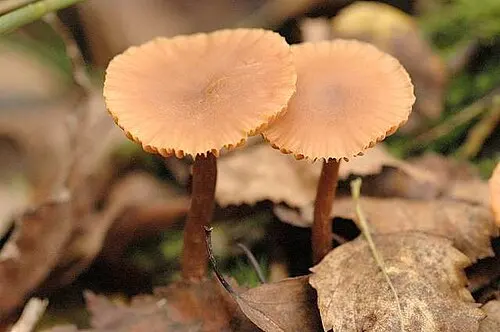 James Lindsey / CC BY-SA 3.0
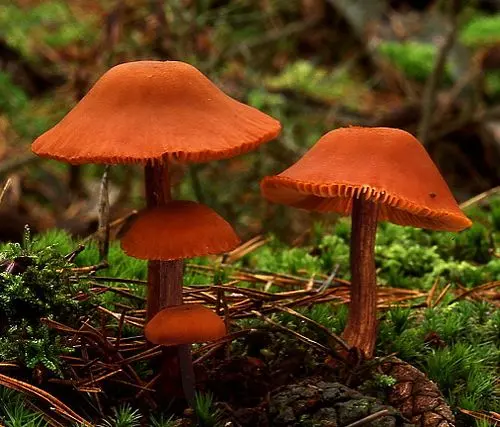 Zonda Grattus / CC BY 3.0
Species to compare
Similar mushrooms to compare against: