

About this fungus
Spring Fieldcap is a fungus in the Strophariaceae family. Its habitat and field characteristics are summarised below.
A medium-sized brown-spored mushroom that often appears on woodchip and disturbed ground in spring or early summer. Young caps are yellow-brown to honey-coloured but can fade to pale tan, cream or almost white. A fragile white partial veil usually leaves fragments at the cap margin or a thin ring on the stem.
What to check
Look for close, narrowly attached gills that begin whitish, turn greyish and mature brown. The cap is smooth, dry to slightly greasy when young and may crack in dry weather. A thin skirt-like ring often develops a brown upper edge as spores fall, but it can break up or disappear. The pale stem commonly has a slightly swollen base attached to white mycelium or cord-like rhizomorphs. There is no volva, and the spore print is medium brown.
Variation
Cap colour changes greatly with age and moisture, from yellow-brown or honey-coloured to pale tan or nearly white. Veil fragments may cling to a young cap edge, form a complete ring or become difficult to find on older fruit bodies. Caps can remain smooth or develop a network of cracks as they dry. These variations overlap with related fieldcaps, so one feature is not enough for a species-level identification.
Lookalikes
Agrocybe dura, also called Agrocybe molesta, is often paler, favours grassy ground and commonly develops a strongly cracked cap. Agrocybe paludosa is associated with marshes and bogs. Cyclocybe cylindracea grows from poplar, willow and other broadleaf wood and is usually more robust. North America also has close members of the Agrocybe praecox complex that may require microscopic or DNA evidence. Galerina marginata is dangerously poisonous and can grow from wood, but usually has a more rusty-brown spore print and different cap and gill characters.
Habitat and range
Saprotrophic on buried woody debris, landscaping woodchips, garden compost and other organic-rich disturbed ground. It is frequent beside paths, in parks, gardens, urban plantings and woodland edges, usually in loose groups or clusters. The species or species complex is widespread across Europe and North America and is also well documented in parts of Asia and Oceania. Spring and early summer are typical in temperate regions, while warmer climates can support fruiting in other seasons.
Food safety
Edibility is uncertain or disputed.
Photographs
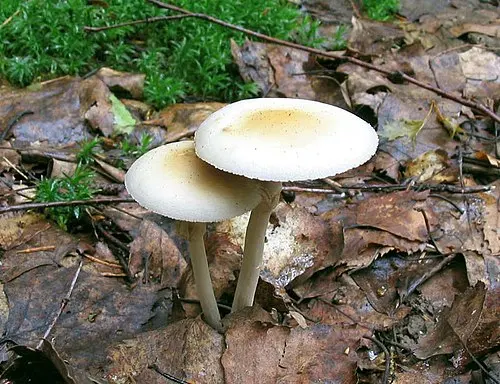 Igor Lebedinsky / CC BY 3.0
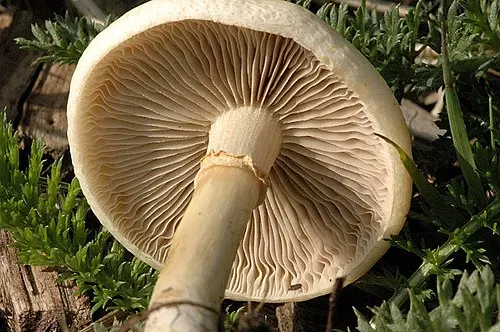 James Lindsey / CC BY-SA 3.0
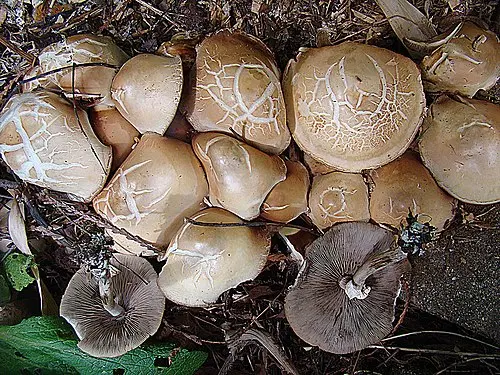 Dick Culbert / CC BY 2.0
Species to compare
Similar mushrooms to compare against: