

About this fungus
St George's Mushroom is a fungus in the Lyophyllaceae family. Its habitat and field characteristics are summarised below.
A thick-fleshed cream to pale buff mushroom appearing in spring, often in arcs or rings in grass, with a firm cap and stocky ringless stem.
What to check
Confirm very crowded, narrow, white to cream gills that meet the stem with a shallow notch, a white spore print and a strong mealy or freshly milled flour odour. The cap is smooth rather than radially fibrous, and the flesh does not redden when bruised. There is no ring or volva. No single feature is sufficient where poisonous fibrecaps occur.
Lookalikes
The deadly fibrecap, Inosperma erubescens, formerly Inocybe erubescens or I. patouillardii, can share the spring season and calcareous grassland. Its cap becomes radially fibrous, the flesh often reddens, and its spores are brown, but young gills can still be pale. Entoloma sinuatum is poisonous and develops pink spores. Small white Clitocybe species can contain muscarine and should also be excluded.
Habitat and range
Saprotrophic in grassland, verges, parks and woodland edges, often on lime-rich or chalky soils and frequently forming arcs or rings. It is mainly a European and western Asian spring species; season shifts with climate and altitude.
Food safety
Edible, with caution.
Use this profile to learn what to examine and compare, not as proof that a mushroom is safe to eat. Check the whole specimen and every important lookalike before reaching an identification.
Photographs
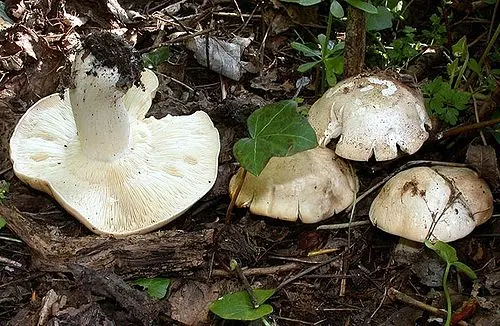 Japonica / Public Domain
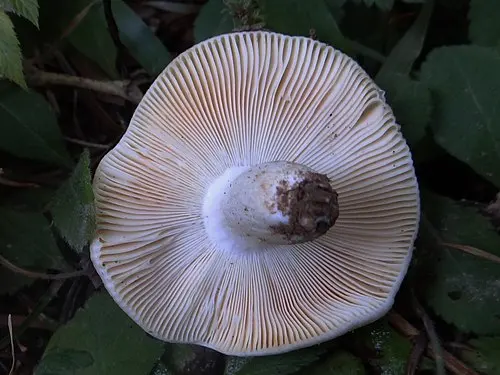 Jerzy Opioła / CC BY-SA 3.0
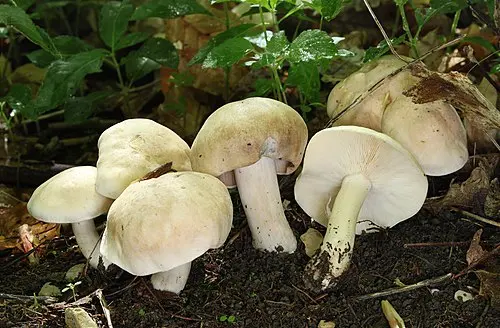 Holger Krisp / CC BY 3.0
Species to compare
Similar mushrooms to compare against: