

About this fungus
Stinking Brittlegill is a fungus in the Russulaceae family. Its habitat and field characteristics are summarised below.
A large honey-brown brittlegill with a very sticky cap, deeply grooved margin and a strong unpleasant smell that becomes more fish-like with age.
What to check
Look for a viscid ochre to brown cap with a long-lined margin, brittle cream gills that develop rusty spots, a white stem that may become hollow, and a white to cream spore print. There is no ring or volva.
Variation
The cap is glutinous when wet but can dry dull and patchy. Older mushrooms become darker, more strongly spotted and more unpleasant-smelling.
Lookalikes
Russula grata has a bitter-almond or marzipan-like smell, while R. subfoetens is extremely similar and may require chemical or microscopic study. Regional members of the Foetentinae group are not reliably separated by cap colour alone.
Habitat and range
Mycorrhizal on woodland soil with broadleaf or conifer trees. Tree associations and the exact limits of similar foul-smelling Russulas vary geographically.
Food safety
Inedible.
Photographs
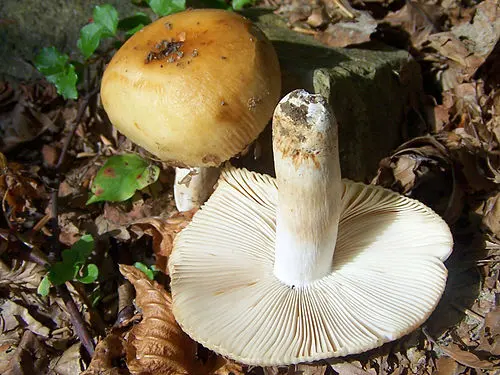 Jerzy Opioła / CC BY-SA 4.0
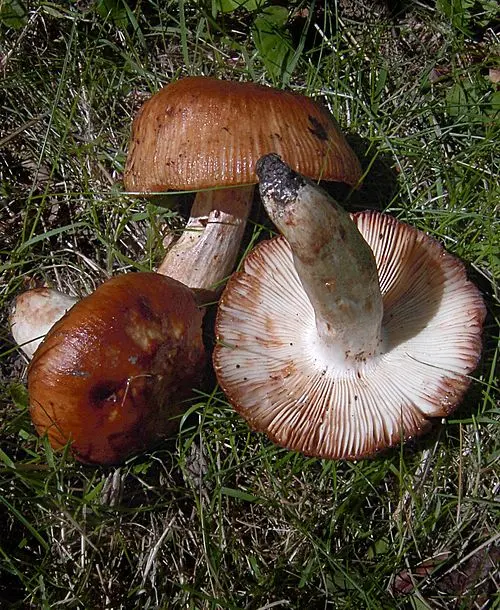 Thkgk / CC BY-SA 3.0
Species to compare
Similar mushrooms to compare against: