
About this fungus
Stump Puffball is a fungus in the Agaricaceae family. Its habitat and field characteristics are summarised below.
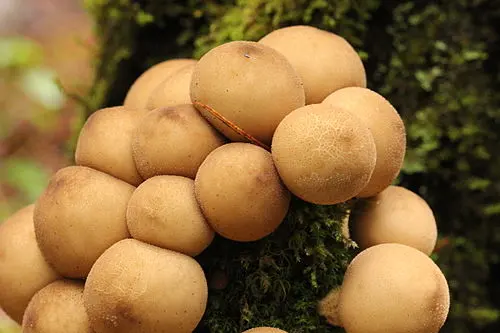
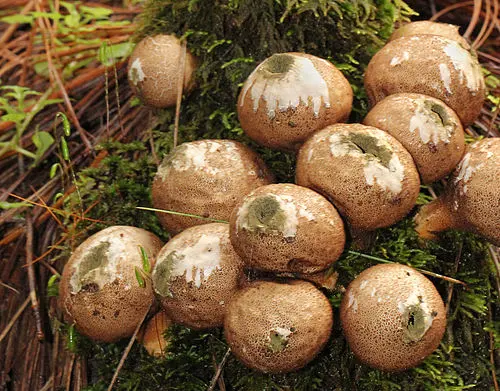
A small pear-shaped puffball that usually forms dense troops on stumps, logs or buried wood. Young bodies are pale and finely granular, ageing through yellow-brown to darker brown.
What to check
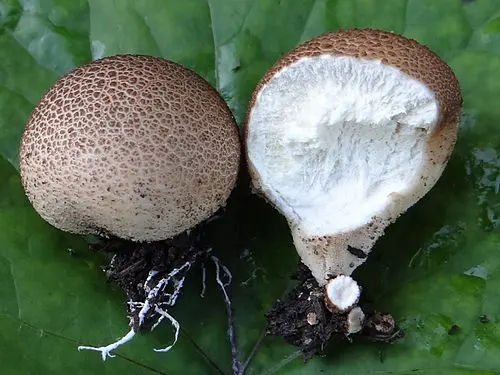
Trace the narrowed base to dead wood or to white mycelial cords leading into buried timber. If considering food use, cut every specimen from top to bottom. The upper spore-bearing flesh must be firm and evenly white, with no cap, stem or gill outline. The lower sterile base may look chambered, but it must not contain a developing mushroom.
Variation
Young fruit bodies are white to cream with fine warts or granules. These wear away as the body turns yellow-brown, grey-brown or dark brown. Mature specimens develop a pore at the top and contain olive-brown powdery spores.
Lookalikes
Common Puffball normally grows on soil and has larger detachable spines that leave net-like scars. Earthballs develop a firm dark or marbled interior. An immature Amanita button shows the outline of a cap, stem and gills when cut vertically, unlike the white upper flesh of a true young puffball.
Habitat and range
A widespread wood-decaying fungus on broadleaf and conifer stumps, logs, roots and buried timber. It often fruits in crowded clusters and can appear to grow from soil when its woody substrate is underground.
Food safety
Edible.
Use this profile to learn what to examine and compare, not as proof that a mushroom is safe to eat. Check the whole specimen and every important lookalike before reaching an identification.
Photographs
 2012 Alan Rockefeller / CC BY-SA 3.0
 Jerzy Opioła / CC BY-SA 3.0
Species to compare
Similar mushrooms to compare against: