

About this fungus
Summer Bolete is a fungus in the Boletaceae family. Its habitat and field characteristics are summarised below.
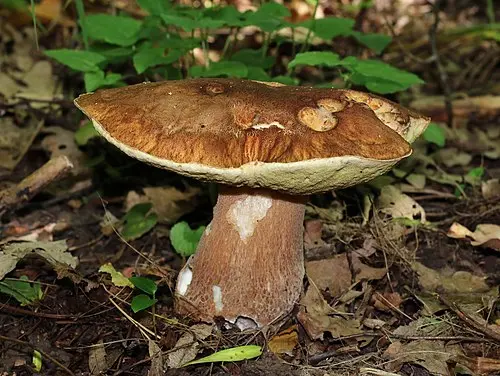
A robust European cep with a dry, velvety brown cap, pale pores and a pale stem covered by a raised net-like pattern. It often fruits earlier in the year than Boletus edulis and is especially associated with warm broadleaved woodland.
What to check
Check that the stem network is well developed over much of the stem, the pores begin white and become yellow to olive, and the white flesh does not turn blue when cut. There is no ring or volva. The dry cap may crack in warm weather, but cracking alone is not diagnostic.
Variation
Caps range from pale tan to mid or dark brown and may remain smooth or develop a fine cracked mosaic in dry conditions. Stems range from club-shaped to more cylindrical. The pore surface changes from white to yellow-green with age without a strong blue reaction.
Lookalikes
Boletus edulis often has a paler cap margin and a less extensive stem network, but the two can overlap. Boletus aereus is usually darker. Bitter Bolete, Tylopilus felleus, develops pinkish pores and often has a darker coarse stem net. Some toxic red-pored boletes may be brown-capped, so pore colour and staining must be checked.
Habitat and range
Ectomycorrhizal with broadleaved trees, especially oak, beech and sweet chestnut, across Europe and nearby temperate regions. It fruits from late spring through autumn where conditions are suitable. Similar cep-like boletes outside its established range should be assessed with local sources.
Food safety
Choice edible.
Use this profile to learn what to examine and compare, not as proof that a mushroom is safe to eat. Check the whole specimen and every important lookalike before reaching an identification.
Photographs
 Attribution pending
Species to compare
Similar mushrooms to compare against: