
About this fungus
The Gypsy is a fungus in the Cortinariaceae family. Its habitat and field characteristics are summarised below.
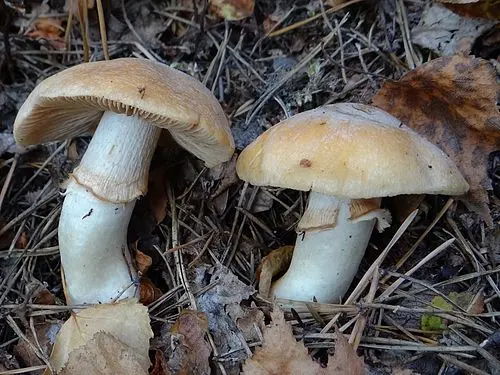
A stout northern woodland mushroom with a dry yellow-buff to ochre cap. The cap often looks frosted when young and becomes conspicuously wrinkled around a broad central boss.
What to check
Look for a true, persistent whitish membranous ring, a feature that separates it from most webcaps with only a cobweb-like cortina. The crowded gills begin pale clay and mature to ochre or cinnamon-brown. The stem is pale and slightly swollen at the base, without a volva.
Lookalikes
Agrocybe praecox lacks the same wrinkled frosted cap, while Phaeolepiota aurea has a more granular surface. Other Cortinarius species can share brown colours and rusty spores but usually lack the substantial persistent ring. Cortinarius includes deadly kidney-toxic species, so the ring must be assessed with all other characters rather than used alone.
Habitat and range
Mycorrhizal with conifers, beech, birch and ericaceous shrubs such as heather and bilberry. It is most characteristic of cool northern and montane regions and often occurs on acidic, nutrient-poor soil.
Food safety
Edible, with caution.
Use this profile to learn what to examine and compare, not as proof that a mushroom is safe to eat. Check the whole specimen and every important lookalike before reaching an identification.
Photographs
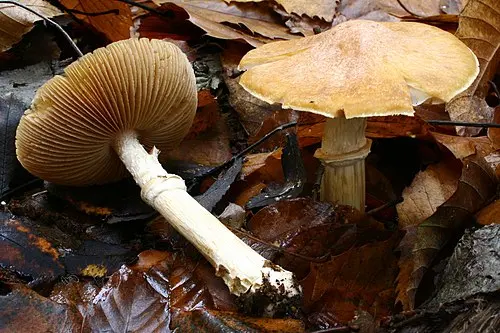 Strobilomyces / CC BY-SA 3.0
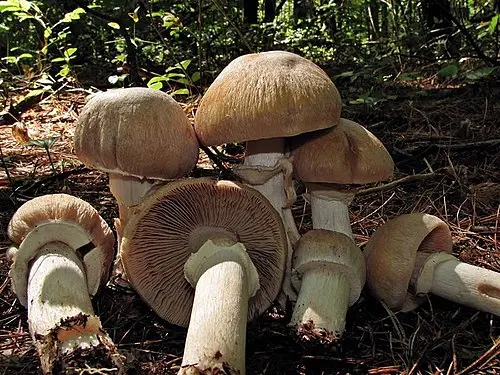 Eric Smith (esmith) / CC BY-SA 3.0
Species to compare
Similar mushrooms to compare against: