

About this fungus
Velvet Shank is a fungus in the Physalacriaceae family. Its habitat and field characteristics are summarised below.
A cold-season wood-rotting mushroom that forms clusters of glossy yellow-orange to brown caps. The lower stem develops a dark brown, finely velvety covering that gives the species its English name.
What to check
Look for a 2 to 10 cm sticky cap, pale cream to yellowish gills, and a tough stem that is pale near the cap but dark brown and velvety below. The spore print is white. There is no ring or volva. Check several mature fruit bodies because young stems may not yet be dark and a fragile ring on a dangerous lookalike can disappear.
Variation
Caps range from yellow-orange and honey-brown to deeper reddish-brown, usually darker at the centre and slimier when wet. Cold or exposed clusters can be distorted. Cultivated white, long-stemmed enoki is usually the Asian species Flammulina filiformis grown in special conditions, not the normal appearance of wild European F. velutipes.
Lookalikes
Funeral Bell, Galerina marginata, is deadly poisonous and also grows on wood. It has a rusty-brown spore print rather than white and often a ring or ring zone, although the ring can be lost. Sheathed Woodtuft also has brown spores and a ring. Do not rely on cap colour, season or clustering; the dark velvety lower stem and a white spore print must agree with the rest of the identification.
Habitat and range
Saprobic and sometimes weakly parasitic on dead or damaged broadleaved wood, including elm, willow, beech, ash and horse chestnut. It commonly fruits from autumn through winter and into spring in cool temperate regions. Similar Flammulina species replace or overlap with it elsewhere.
Food safety
Edible, with caution.
Use this profile to learn what to examine and compare, not as proof that a mushroom is safe to eat. Check the whole specimen and every important lookalike before reaching an identification.
Photographs
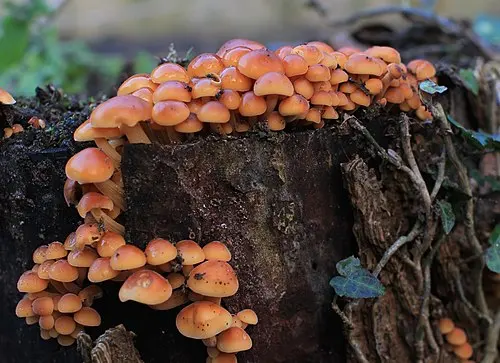 Stu's Images / CC BY-SA 4.0
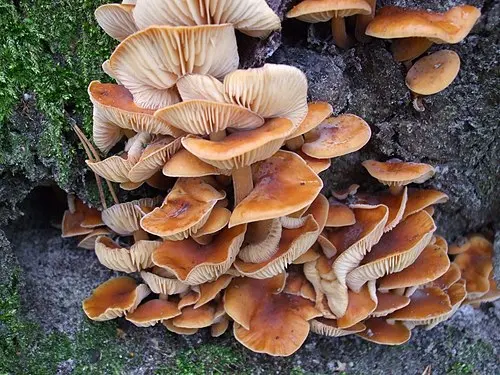 Tomasz Przechlewski / CC BY 2.5
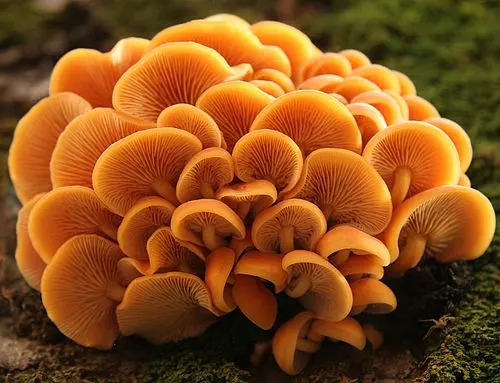 Kork / CC BY-SA 2.5
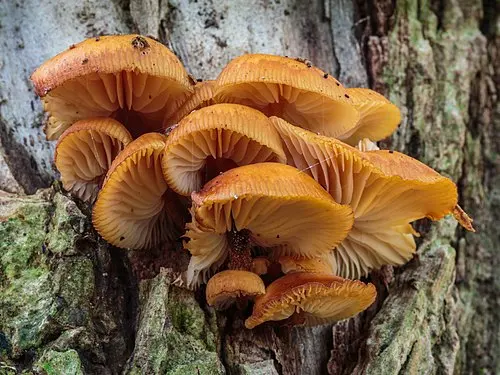 Dominicus Johannes Bergsma / CC BY-SA 4.0
Species to compare
Similar mushrooms to compare against: