

About this fungus
Wavy Cap is a fungus in the Hymenogastraceae family. Its habitat and field characteristics are summarised below.
A small caramel-brown mushroom that often grows in crowded groups from woodchip or other buried woody debris. The cap begins rounded, then spreads and develops the strongly rippled edge behind the name Wavy Cap. Damp caps are darker and slightly sticky; drying caps fade through tan to pale buff, so one patch can contain several colours at once.
Identification features to check
Check the whole combination rather than relying on the wavy edge. The cap is usually 2 to 5 cm across, smooth and hygrophanous, meaning it changes colour as it loses water. Gills are attached or run very slightly down the stem, becoming dark purple-brown while their edges often remain pale. The stem is whitish and fibrous, with no lasting ring or basal cup, and may stain blue or blue-green after damage. A very dark purple-brown spore print supports the identification. Blueing is useful but is not unique to this species, and a specimen that does not show it is not automatically a safe lookalike.
Lookalikes
Funeral Bell, Galerina marginata, is the critical comparison because it also grows on decaying wood and contains amatoxins that can cause liver failure. It has a cinnamon to rusty-brown spore print rather than a dark purple-brown one and does not blue, but its ring can be weak or lost and no single feature should be trusted. Psilocybe allenii and other close wood-growing Psilocybe can overlap in colour, bruising and habitat, and DNA work has found misnamed museum specimens. Tubaria and other small brown woodchip mushrooms add further confusion. Mixed clusters must not be assumed to contain only one species.
Habitat and range
Saprotrophic on decaying woody material, especially landscaped woodchip mulch, but also sawdust and other woody debris. It is most often seen in parks, gardens, path edges and similar planted places rather than on living wood. Fruiting follows cool, wet weather and is mainly autumn into winter. It is recorded in western North America, Britain and mainland Europe, and has also been introduced to other temperate regions including Australia and New Zealand.
Food safety
Psychoactive.
Photographs
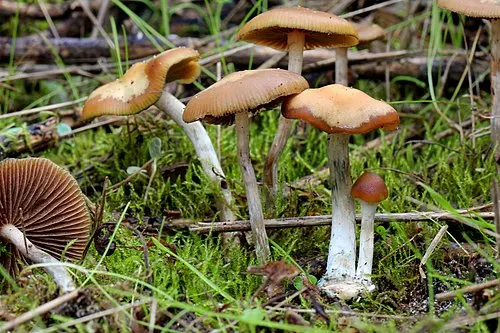 Alan Rockefeller / CC BY-SA 3.0
Species to compare
Similar mushrooms to compare against: