
About this fungus
Weeping Bolete is a fungus in the Suillaceae family. Its habitat and field characteristics are summarised below.
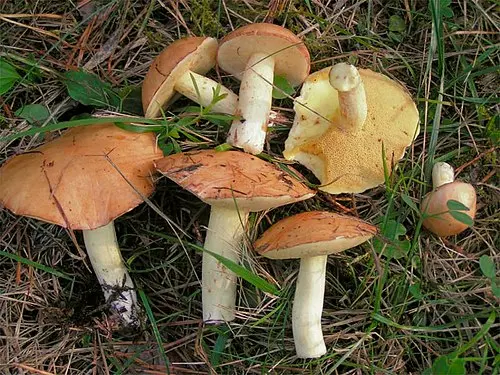
A ringless pine bolete with a sticky cinnamon to orange-brown cap, small yellow pores and brown glandular dots near the top of the stem. Young pores often produce pale milky droplets.
What to check
Check for pores rather than gills, pale droplets on young pore surfaces, brown granules at the stem apex and no ring or volva. Confirm a nearby two-needle pine. Droplets may be absent in dry or old specimens, so the ringless dotted stem and host remain important.
Variation
Wet caps are darker and more slippery, while dry caps become paler and shinier. Pore droplets dry into brown spots, and older pores turn dull yellow to olive. The cap ranges from yellow-brown through cinnamon to orange-brown.
Lookalikes
Suillus luteus has a persistent ring. Suillus collinitus is ringless but often shows pink basal mycelium and a radially streaked cap. Suillus bovinus has larger angular pores. Regional Suillus can be difficult, so the complete stem base and host should be recorded.
Habitat and range
Mycorrhizal mainly with two-needle pines in woodland, plantations, parks and other planted ground. It is native across the Northern Hemisphere and has been introduced with pine into parts of the Southern Hemisphere.
Food safety
Edible.
Use this profile to learn what to examine and compare, not as proof that a mushroom is safe to eat. Check the whole specimen and every important lookalike before reaching an identification.
Photographs
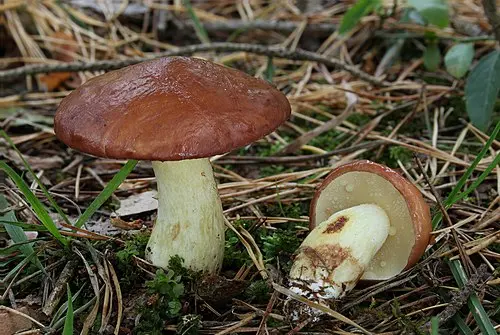 H. Krisp / CC BY 3.0
Species to compare
Similar mushrooms to compare against: