
About this fungus
Slippery Jack is a fungus in the Suillaceae family. Its habitat and field characteristics are summarised below.
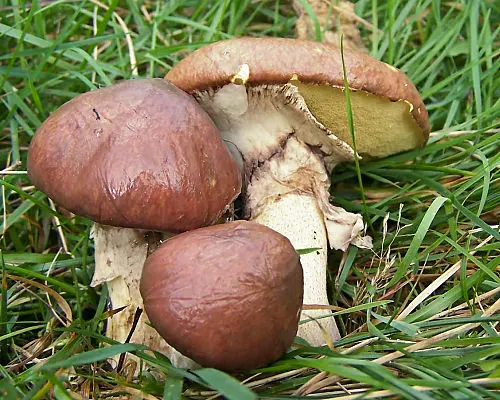
A pine-associated bolete with a brown cap that becomes strongly slimy in wet weather, yellow pores and a persistent membranous ring. The combination of a ring and a pore surface, rather than gills, is a useful first clue.
What to check
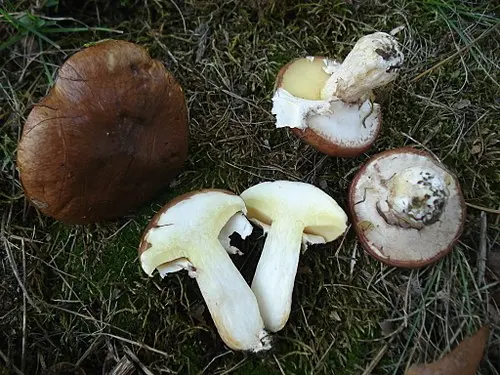
Check for a peelable, viscid brown cap, small yellow pores, a well-developed ring and glandular dots on the upper stem. There is no volva. Confirm that pine is present nearby, since similar Suillus species can be tied to larch or other conifers.
Variation
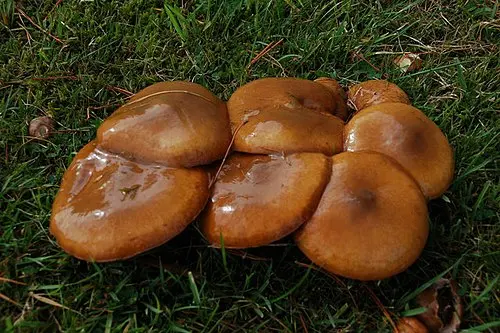
The cap ranges from yellow-brown to dark chestnut and can look glossy when wet or duller in dry weather. Pores darken with age. The ring begins pale and can become brown or purplish beneath as spores and age stain it.
Lookalikes
Suillus grevillei is usually brighter yellow or orange and grows with larch. Suillus granulatus lacks a ring, while Suillus brevipes may have a shorter stem and also lacks the persistent ring. Tree partner, ring structure, glandular dots and pore colour are more useful than cap colour alone.
Habitat and range
Ectomycorrhizal mainly with pine. Native across much of the Northern Hemisphere and introduced with planted pines in parts of South America, southern Africa, Australia and New Zealand. It occurs in plantations, woodland, parks and other pine-rich ground, not only in damp sites.
Food safety
Edible.
Use this profile to learn what to examine and compare, not as proof that a mushroom is safe to eat. Check the whole specimen and every important lookalike before reaching an identification.
Photographs
 Dave W / CC BY-SA 3.0
 Aubrey Dale / CC BY-SA 2.0
Species to compare
Similar mushrooms to compare against: