

About this fungus
Wood Mushroom is a fungus in the Agaricaceae family. Its habitat and field characteristics are summarised below.
A white to cream woodland Agaricus, often with an aniseed or almond-like odour and gentle yellowing where handled.
What to check
Confirm free gills that become pink and then chocolate-brown, a persistent skirt-like ring, and no volva at the fully excavated stem base. Yellowing is usually gradual. Odour and staining support an identification but are variable and must not replace the gill, spore and stem-base checks.
Variation
Caps become cream or yellowish with age and handling. The aniseed-like odour and yellow reaction can be weak, especially in old or dry specimens.
Lookalikes
Yellow Stainer, Agaricus xanthodermus, usually turns vivid chrome-yellow rapidly at the stem base and often has a phenolic or inky odour, although neither response is always strong. Young Agaricus can be confused with deadly Amanita species, whose gills remain white and whose base may have a volva. Examine mature material and the complete stem base.
Habitat and range
Saprotrophic in leaf litter in broad-leaved and conifer woodland, usually singly or in small groups. Woodland habitat alone does not establish the species.
Food safety
Edible, with caution.
Use this profile to learn what to examine and compare, not as proof that a mushroom is safe to eat. Check the whole specimen and every important lookalike before reaching an identification.
Photographs
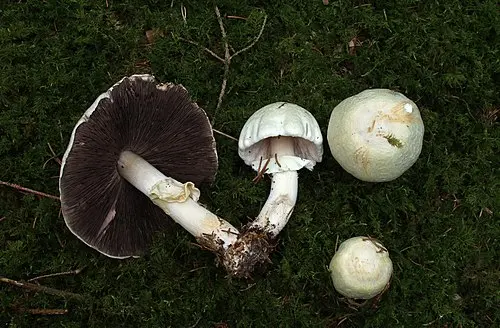 H. Krisp / CC BY 3.0
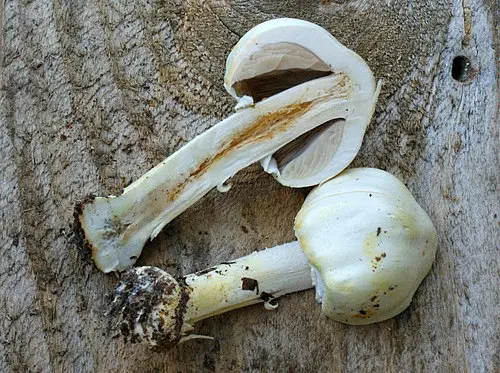 Johann Harnisch / CC BY-SA 3.0
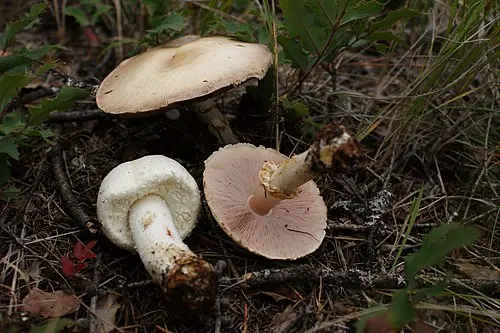 Johann Harnisch / CC BY-SA 3.0
Species to compare
Similar mushrooms to compare against: