

About this fungus
Caesar's Mushroom is a fungus in the Amanitaceae family. Its habitat and field characteristics are summarised below.
A large southern European Amanita with a smooth orange to red-orange cap, yellow gills, a yellow stem and ring, and a loose white sack at the stem base. The cap margin becomes clearly lined as it opens.
What to check
Examine a fully developed fruit body and expose the entire stem base. Check for free yellow gills, a yellow membranous ring, a yellow stem and a large white sack-like volva. Unopened Amanita buttons cannot be identified safely from their outside appearance, and colour alone is not enough.
Variation
The cap can range from golden orange to deep red-orange and often fades with age. White veil fragments may occasionally remain on the cap, while rain can wash them away. Related Caesar Amanitas in other regions can look extremely similar.
Lookalikes
Fly Agaric usually has white gills and a white stem rather than yellow ones. Amanita crocea and Amanita fulva lack a ring. Death Caps, destroying angels and other dangerous Amanitas can resemble pale or unopened specimens. Regional members of Amanita section Caesareae may require specialist or microscopic examination.
Habitat and range
Mycorrhizal with broadleaved trees, especially oak and sweet chestnut, in warm woodland and open wooded ground. The strict species is centred on southern and central Europe, the Mediterranean region and nearby western Asia. Similar Caesar Amanitas elsewhere should be identified under their regional names.
Food safety
Edible, with caution.
Use this profile to learn what to examine and compare, not as proof that a mushroom is safe to eat. Check the whole specimen and every important lookalike before reaching an identification.
Photographs
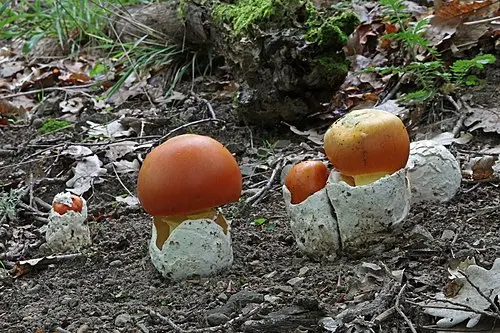 Nikolay Kashpor / CC BY 4.0
Species to compare
Similar mushrooms to compare against: