
About this fungus
Flaky Puffball is a fungus in the Agaricaceae family. Its habitat and field characteristics are summarised below.
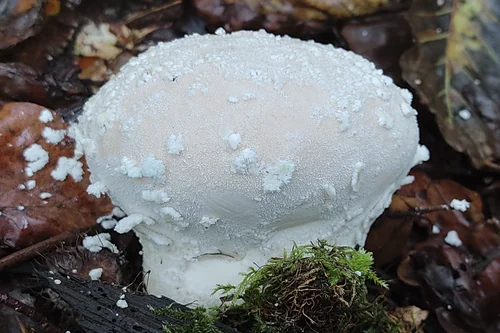
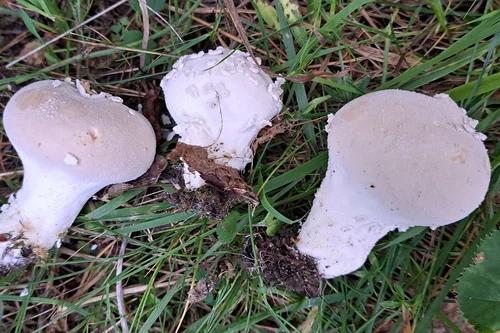
An uncommon pear-shaped to rounded puffball covered when young by large, soft, cottony white patches. As those patches fall away, they expose a smoother cream, pink-buff or ochre inner skin.
What to check
For identification, cut a representative fruit body lengthwise from top to base and inspect the complete interior. A true young puffball is uniform inside, with no outline of a cap, gills or stem. Confirm the large peeling outer flakes, rounded top and broad sterile base. Mature interiors become olive-brown to chocolate-brown and powdery.
Variation
Fresh young fruit bodies are white and conspicuously woolly. The outer patches are easily lost through age, weather or handling, after which the surface may look pink-buff or ochre and much less distinctive. A pore opens at the top when the brown spores mature.
Lookalikes
An immature Amanita can look like a puffball externally but shows a developing cap, gills and stem when cut lengthwise. Earthballs have a tough skin and a dark or marbled interior. Lycoperdon perlatum and Lycoperdon echinatum have different spine patterns and lack the same broad cottony plates.
Habitat and range
Found on calcareous or otherwise alkaline soil in broadleaved woodland, especially beech woodland, and sometimes at woodland edges or nearby grassland. It is uncommon or rare in much of its documented European range and should be left undisturbed.
Food safety
Inedible.
Photographs
 Svencapoeira / CC BY-SA 4.0
Species to compare
Similar mushrooms to compare against: