

About this fungus
Grisette is a fungus in the Amanitaceae family. Its habitat and field characteristics are summarised below.
A tall, slender European woodland Amanita with a smooth grey to grey-brown cap, crowded pale gills and no ring on the stem. The mature cap is almost flat, often with a small central bump, and its edge carries bold comb-like grooves. A loose white sheath surrounds the base. This is the familiar field-guide picture of the Grisette, but modern research shows that very similar grey grisettes can belong to several different species.
What to check
Expose the whole stem base and examine the cap edge as well as the stem. A typical collection has no ring, a long non-bulbous stem and a large loose sack around the base. The cap grooves usually occupy the outer part of the cap rather than running almost to its centre. The gills are crowded, white to cream and narrowly attached or free, and the spore print is white. These features can place a mushroom in the ringless Amanita group, but they do not settle the exact species. European research has found several genetic lineages hidden under the name Amanita vaginata, so difficult collections can require microscopy and DNA.
Variation
The cap may be pale silver-grey, darker mouse-grey or grey-brown, usually with a darker centre. It begins rounded or egg-shaped, then becomes convex and finally nearly flat with a small bump. Loose white veil material may remain on a young cap but is often absent later. Very pale and white grisettes have historically been filed as Amanita vaginata var. alba, yet sequence work has moved some of that material to other species. Lack of pigment should therefore be described as a feature, not used as proof of this species.
Lookalikes
The closest comparisons are other ringless Amanita. Tawny Grisette, Amanita fulva, is normally a richer orange-brown. Orange Grisette, Amanita crocea, has orange or apricot tones and a patterned stem. Snakeskin Grisette, Amanita ceciliae, usually carries grey veil patches on the cap and broken grey bands around the stem rather than a clean loose sack. Regional species can be still closer and may not separate reliably in the field. Deathcap and destroying angels normally develop a ring and have an unlined or much less strongly lined cap edge, but their rings can be damaged or lost. They can also have a sack-like volva, so the sack alone never proves that a collection is a grisette.
Habitat and range
Ectomycorrhizal on soil near living trees. The traditional European species is recorded mainly in broadleaf woodland and sometimes in mixed woodland, with fruit bodies also appearing on grassy woodland edges. In Britain and Ireland it is mainly a summer and autumn mushroom. Grey ringless Amanita occur across other temperate regions, but the European name has often been applied broadly, especially in North America. Local names and regional guides are more dependable outside Europe.
Food safety
Edible, with caution.
Use this profile to learn what to examine and compare, not as proof that a mushroom is safe to eat. Check the whole specimen and every important lookalike before reaching an identification.
Photographs
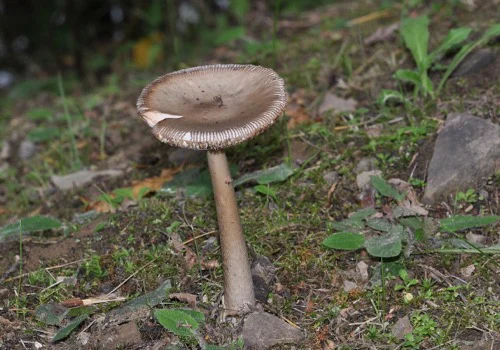 Quartl / CC BY-SA 3.0
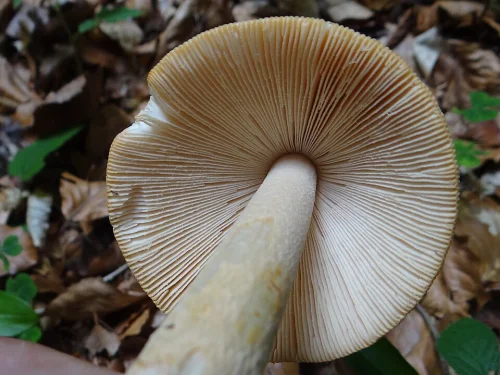 Jerzy Opioła / CC BY-SA 4.0
Species to compare
Similar mushrooms to compare against: