
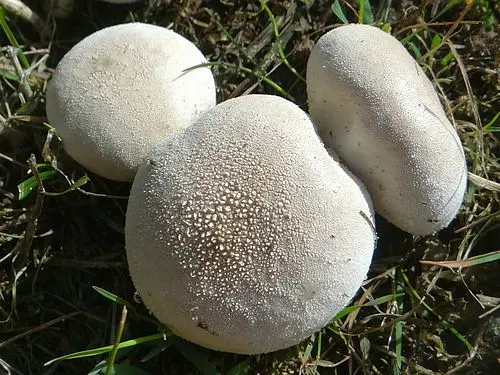
Meadow Puffball

Lycoperdon pratense

Meadow PuffballJerzy Opioła / CC BY-SA 3.0

About this fungus

Meadow Puffball is listed in the Shroomify field guide as a puffballs & earthstars fungus in the Agaricaceae family. Grows in grassland, lawns, golf courses, parks and sand dunes

A note on identification
This profile is a guide rather than a guarantee. If you are considering eating a wild mushroom, check the whole specimen and its possible lookalikes carefully. Do not eat it if you are unsure of the identification.

Further reading

Wikipedia · First Nature

What the records suggest about Meadow Puffball

The project has analysed over a million matched fungal events alongside weather and habitat data. These findings describe patterns in the study, not conditions that every fruitbody must follow.

Ground and bedrock

British records leaned towards lime-rich ground, including chalk and limestone country.

Elevation

Records tended to come from higher ground, about 139 metres above the average elevation of fungal records in the study.

Weather or season?

Recent weather added a smaller but repeatable signal after the normal seasonal pattern had been allowed for.

When does this mushroom tend to appear?

The middle line means there was no difference between this species and other fungi recorded in the same area and part of the season. Warmer and cooler always mean warmer or cooler than normal for that place and time of year, not absolute temperature.

Increase linked with more recordsDecrease linked with more recordsNo clear linkThin line shows uncertainty

Rainfall

Rainier than normal conditions 4 to 7 days beforehand was linked with more records.

Rainier than normalNo changeDrier than normalRainfall 0 to 3 days beforehand did not show a clear link with how often this species was recorded.Rainier than normal conditions 4 to 7 days beforehand was linked with more records of this species.Rainier than normal conditions 8 to 14 days beforehand was linked with more records of this species.Rainfall 15 to 21 days beforehand did not show a clear link with how often this species was recorded.Rainfall 22 to 30 days beforehand did not show a clear link with how often this species was recorded.Drier than normal conditions 31 to 60 days beforehand was linked with more records of this species.0-34-78-1415-2122-3031-60Days before the record

Soil moisture

Drier than normal soil 22 to 30 days beforehand was linked with more records.

Wetter than normalNo changeDrier than normalWetter than normal soil 0 to 3 days beforehand was linked with more records of this species.Soil moisture 4 to 7 days beforehand did not show a clear link with how often this species was recorded.Soil moisture 8 to 14 days beforehand did not show a clear link with how often this species was recorded.Drier than normal soil 15 to 21 days beforehand was linked with more records of this species.Drier than normal soil 22 to 30 days beforehand was linked with more records of this species.Drier than normal soil 31 to 60 days beforehand was linked with more records of this species.0-34-78-1415-2122-3031-60Days before the record

Soil temperature

Warmer than normal soil 15 to 21 days beforehand was linked with more records.

Warmer than normalNo changeCooler than normalSoil temperature 0 to 3 days beforehand did not show a clear link with how often this species was recorded.Cooler than normal soil 4 to 7 days beforehand was linked with more records of this species.Soil temperature 8 to 14 days beforehand did not show a clear link with how often this species was recorded.Warmer than normal soil 15 to 21 days beforehand was linked with more records of this species.Soil temperature 22 to 30 days beforehand did not show a clear link with how often this species was recorded.Soil temperature 31 to 60 days beforehand did not show a clear link with how often this species was recorded.0-34-78-1415-2122-3031-60Days before the record

Air temperature

Warmer than normal air 15 to 21 days beforehand was linked with more records.

Warmer than normalNo changeCooler than normalAir temperature 0 to 3 days beforehand did not show a clear link with how often this species was recorded.Cooler than normal air 4 to 7 days beforehand was linked with more records of this species.Air temperature 8 to 14 days beforehand did not show a clear link with how often this species was recorded.Warmer than normal air 15 to 21 days beforehand was linked with more records of this species.Air temperature 22 to 30 days beforehand did not show a clear link with how often this species was recorded.Air temperature 31 to 60 days beforehand did not show a clear link with how often this species was recorded.0-34-78-1415-2122-3031-60Days before the record

Each point is a separate matched comparison for that weather measure and time window. Clear results must have a meaningful effect, adequate geographic coverage and the same direction in odd and even years. These are associations in field records, not rules or forecasts.

How the Shroomify research works →