

About this fungus
Parasol is a fungus in the Agaricaceae family. Its habitat and field characteristics are summarised below.
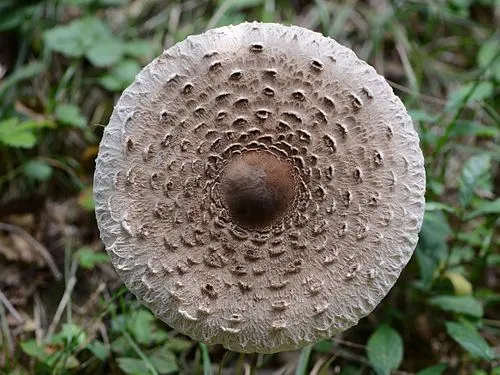
A statuesque mushroom with a broad scaly cap, a dark central boss and a long slender stem patterned like snakeskin. A thick movable ring circles the upper stem.
What to check
Use a mature fruit body to confirm the complete set of characters: a very large pale cap with darker brown scales, free white gills, a white spore print, a long stem with clear brown zigzag or snakeskin bands, a thick double ring that moves freely, and no volva at the base. No single feature is enough.
Variation
Young caps are closed and drumstick-shaped, so the mature cap width and scale pattern are not yet visible. The cap expands through egg-shaped and convex stages to a broad parasol with a persistent central boss. The flesh stays mainly white rather than rapidly staining orange-red.
Lookalikes
Chlorophyllum molybdites is poisonous and common in lawns across warm parts of North America and many tropical regions. Its mature gills and spore print become green, and its stem lacks the Parasol's snakeskin pattern. Chlorophyllum rhacodes, C. brunneum and related shaggy parasols also lack the snakeskin stem and their flesh usually stains orange-red. Some small Lepiota species contain potentially fatal amatoxins. Any immature, undersized or incomplete specimen that lacks the full mature Parasol character set must remain unidentified.
Habitat and range
Saprotrophic on soil in open woodland, woodland edges, pathsides, old pasture, rough grass and stable dunes. The true species is widespread in Europe and parts of temperate Asia and Africa; reports from other regions may involve related Macrolepiota species.
Food safety
Choice edible, with caution.
Use this profile to learn what to examine and compare, not as proof that a mushroom is safe to eat. Check the whole specimen and every important lookalike before reaching an identification.
Photographs
 rufre@lenz-nenning.at / CC BY-SA 3.0 AT
 Andreas Eichler / CC BY-SA 4.0
Species to compare
Similar mushrooms to compare against: