

About this fungus
Scarletina Bolete is a fungus in the Boletaceae family. Its habitat and field characteristics are summarised below.
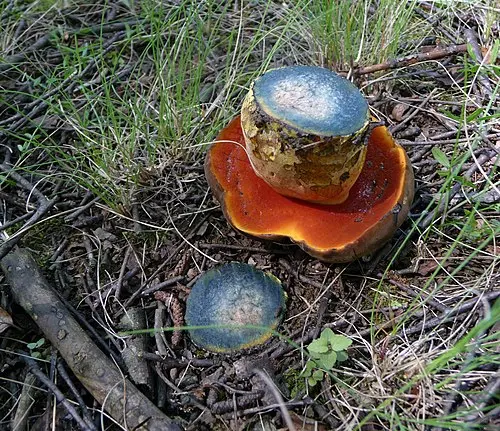
A solid, dark-capped bolete with a fiery underside. The pore surface matures from yellow-orange to orange-red or deep red, and the yellow stem is densely dusted with tiny red dots rather than covered by a raised net. Cut or bruised flesh can turn dark blue within seconds, producing one of the most dramatic colour changes among European boletes.
What to check
Check the whole mushroom, not just the blue reaction. Look for a dark brown, often velvety cap, small orange-red to red pores, and fine red dots packed over a yellow stem. The dots remain separate or merge into a granular covering but do not form the raised mesh seen on several lookalikes. Slice a complete fruit body lengthways if identification requires it: the flesh should begin yellow and turn strongly blue very quickly across cap and stem. There is no ring or volva. The spore print is olive-brown.
Variation
The cap ranges from deep chocolate and bay brown to olive-brown or coppery brown, sometimes with a reddish cast. Very young pores may still be yellow before becoming orange and then red. Stem dots can be sparse near the top or so dense lower down that the surface looks almost solid red. Bruising is usually immediate and intense but can be weaker in old, dry or damaged specimens. A yellow form has also been described. These variations do not remove the need to check stem texture, pore colour and a full cut section together.
Lookalikes
Lurid Bolete, Suillellus luridus, normally has a raised red net on the stem rather than fine dots and often shows a reddish line in the flesh just above the tubes. Devil's Bolete, Rubroboletus satanas, has a much paler whitish or grey cap and a bulbous stem with obvious red netting. Other Rubroboletus species can also have pale or pinkish caps and reticulate stems. Neoboletus xanthopus can look extremely close and may need microscopy or DNA. Red pores and blue staining occur in several unrelated boletes, so neither feature identifies Scarletina by itself.
Habitat and range
Ectomycorrhizal on soil with living trees, especially beech, oak and spruce, and also with other broadleaf trees and conifers. It often favours acidic woodland soils and can occur from lowland woods to montane conifer forest. Fruiting is mainly from summer into autumn. The well-supported Scarletina concept is primarily European. Similar red-pored, blue-staining boletes in North America and Asia include different species, so users outside Europe should rely on regional sources rather than transferring this name from a European photograph.
Food safety
Edible, with caution. Requires thorough cooking; raw or undercooked specimens can cause stomach upset.
Use this profile to learn what to examine and compare, not as proof that a mushroom is safe to eat. Check the whole specimen and every important lookalike before reaching an identification.
Photographs
 George Chernilevsky / Public Domain
Species to compare
Similar mushrooms to compare against: