
About this fungus
Sickener is a fungus in the Russulaceae family. Its habitat and field characteristics are summarised below.
A vivid red brittlegill of wet, nutrient-poor conifer woodland. Its smooth cap is rounded at first, then spreads out and often develops a shallow central hollow. Beneath it are crowded white to very pale cream gills and a chalky white stem. Like other Russula species, its flesh breaks with a clean, crumbly snap rather than bending into fibres.
What to check
Look for the whole combination. The smooth scarlet or cherry-red cap can peel for much of the distance towards the centre, often exposing pink tissue immediately below the skin. Mature margins can show short grooves, and the centre can become shallowly depressed. The crowded gills remain white to very pale cream and meet the stem narrowly or may appear almost free. The spore print is white to very pale cream. The white stem has no ring and its base has no volva. Record the nearby trees, moisture and spore characters because a red cap by itself does not establish the species.
Variation
Rain can wash pigment from the cap, leaving pink, orange-red, ochre or nearly pale patches, while sheltered young mushrooms may remain intensely scarlet. Caps progress from rounded or convex to flat and sometimes shallowly funnelled. The stem can yellow slightly with age. Size and fading overlap strongly with other red brittlegills, so neither a particularly bright nor a particularly pale specimen is decisive.
Lookalikes
Many red Russula species are close matches. Russula nobilis is associated with beech in Europe, while R. betularum is linked with birch and is usually smaller and paler. Russula paludosa is often larger and more robust, and R. aquosa can share wet conifer and Sphagnum habitat. In North America, R. silvicola and other red brittlegills have often been recorded under the name R. emetica. Host tree, cap-skin structure, spore-print shade, microscopic spore ornamentation and sometimes DNA are needed for confident separation. Treat a field identification based only on red colour and brittle flesh as provisional.
Habitat and range
Ectomycorrhizal with conifers, especially pine and spruce, on damp, acidic, nutrient-poor ground. It is often found among Sphagnum, woodland moss and needle litter and can occur on wet heath with nearby conifer roots. Fruiting is mainly from summer into autumn in northern temperate regions. The name is firmly established in Europe but has also been applied to several similar regional species, so records outside Europe should be interpreted through a current local Russula key.
Food safety
Poisonous.
Photographs
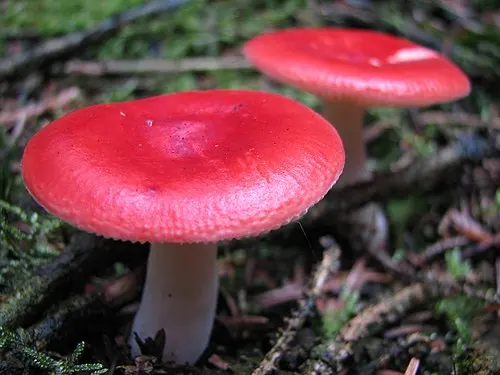 Dohduhdah / Public Domain
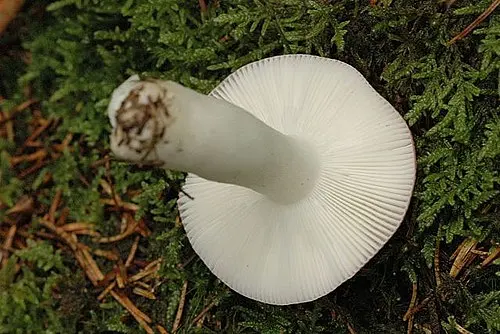 James Lindsey / CC BY-SA 3.0
Species to compare
Similar mushrooms to compare against: