
About this fungus
Common Fieldcap is a fungus in the Strophariaceae family. Its habitat and field characteristics are summarised below.
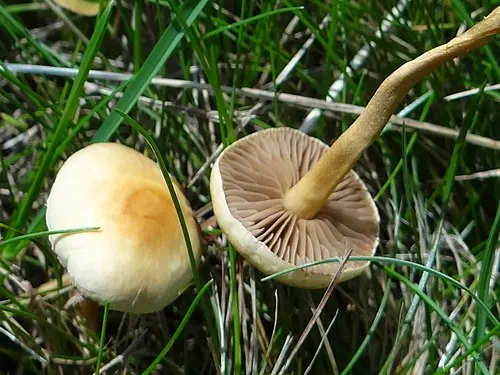
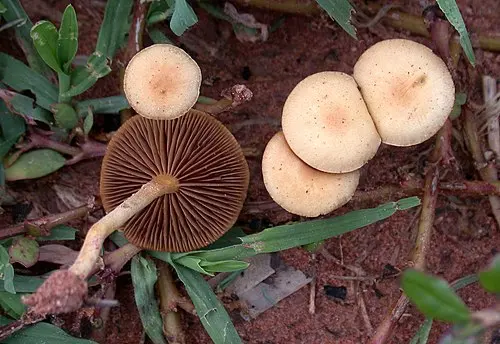
A small, neat field mushroom scattered through lawns and short grass. Fresh caps are smooth, honey-yellow to ochre or pale brown and may feel slightly greasy. They begin rounded or broadly conical, then open to a broad convex or nearly flat shape on a thin pale stem. Mature gills and a dull brown spore print provide the darker contrast.
What to check
Look for narrowly attached gills that begin pale yellow-brown or creamy beige and mature through grey-brown to rust-brown. The stem is slender, often finely fibrillose and normally has no ring, although tiny young buttons can carry a fleeting white veil at the cap margin. A dull cinnamon-brown to dark brown spore print helps separate white-spored lawn mushrooms, while evenly brown gills differ from the mottled gills of many Panaeolus and Panaeolina species. Microscopy may still be needed for a secure species identification.
Variation
Caps fade noticeably as they dry, so one group can range from warm honey or ochre to pale buff. Fresh caps may be slightly sticky while dry ones look matt. Most are only a few centimetres across, but dung-associated material placed in A. pediades var. fimicola can be larger, retain more veil material and develop a cracked margin. Taxonomists do not always divide the wider A. pediades group in the same way.
Lookalikes
Mower's Mushroom, Panaeolina foenisecii, often dries unevenly into light and dark zones and has mottled gills with a darker brown print. Fairy Ring Champignon, Marasmius oreades, has a white spore print and a tougher stem. Spring Fieldcap, Agrocybe praecox, is usually larger and commonly keeps a ring or ring zone. Stropharia coronilla has a more evident ring and purple-brown spores. Some brown Hebeloma can appear nearby, often with trees, and identification should not rest on cap colour alone.
Habitat and range
Saprotrophic in lawns, pasture, meadows, grassy parkland, roadside verges, gardens and coastal dune grass. It usually fruits scattered or in loose groups rather than tight wood-growing clusters. Records also occur from woodchips, compost and dung-rich ground. Fruiting season varies with climate and moisture, from spring through autumn in temperate regions and for much of the year in warm or irrigated places. The species is reported from Europe, the Americas, Asia and Oceania.
Food safety
Inedible.
Photographs
 Len Worthington (lennyworthington) / CC BY-SA 3.0
Species to compare
Similar mushrooms to compare against: